Showing posts with label Units of inquiry. Show all posts
Showing posts with label Units of inquiry. Show all posts
Sunday, November 24, 2013

Wednesday, September 4, 2013
Wiki project
Students of Grade 5 were grouped according to different cultures around the world. They made a wiki based on their research:
http://grade5culture.wikispaces.com/
Please feel free to comment on the wiki - We will continue to use the wiki for the rest of the unit.
http://grade5culture.wikispaces.com/
Please feel free to comment on the wiki - We will continue to use the wiki for the rest of the unit.
Snapshots
 |
| Carousel activity |
 |
| Gallery Walk |
 |
| More-True-than-False |
 |
| Drop-everything-and-read (DEAR) time |
 |
| Math project on data analysis |
 |
| Surya and Ishan begin the Grade 5 Assembly |
 |
| Aly and Aviral give an introduction to the wiki |
 |
| Khushi and Umar talk about African culture |
 |
| Sharon and Zahir talk about Bengali culture |
 |
| Safa and Aayush talk about Chinese culture |
 |
| Using manipulatives to create word problems in maths |
 |
| solving math problems in pairs |
 |
| Novel study: Prediction |
 |
| Using Think-Puzzle-Explore for analysing artefacts |
 |
| Presenting artefacts to class |
 |
| Making a collage |
Wednesday, August 21, 2013
Thinking critically about 'culture'
When we analyse the 'What are we going to teach?' (The Written Curriculum) at our schools, we always try to encompass issues that can make the students think - not just think, but think critically. The usual notion is that units that have a heavy science and/or social studies component are the ones that can help us achieve this purpose. Maybe we need to think differently..
The current unit for Grade 5 is on traditions and rituals and the central idea is "Traditionals, rtiuals and artefacts of different cultures are expressions of their beliefs and values". When you read the central idea, it probably seems rather simple. One might assume that the students might just research about the different cultures around the world, their rituals and traditions and the reasons behind them. Certainly, this is inclusive during inquiry lessons. However, interestingly, the unit involves a lot of critical thinking as well. The reason being that students (as well as many adults!!) have numerous misconceptions about 'culture'.
The first line of inquiry is 'What constitutes a culture'. To enable students inquire into this, we thought of a few provocations:
- Is 'culture' same as 'religion'?
- Does Culture change over time?
- How is our daily routine connected to our culture?
- Is one's culture influenced by other factors? (weather/climate, interaction with other cultures, migration/globalization)
- Should we always believe in whatever our parents believe?
Many such statements were given to the students of Grade 5 during the early stages of the unit. They were asked to arrange these statements on a continuum that range from 'More True than False' to 'More False than True'.
Honestly, this learning engagement turned out to be more effective than I had imagined. The students began to have highly insightful conversations. Every student placed the statements differently. Since their knowledge and understanding of the term 'culture' was quite sketchy, their assumptions and misconceptions were clearly evident. For example, many students thought that culture is the same is religion. 'How can culture change?' was also a common question. They also wondered how their daily routine was connected to their culture.
Followed by this, the students put up questions on the 'inquiry wall'. At the moment, students are doing a variety of learning engagements (Culture ice-berg, watching movies/videos, conducting research by reading fiction and non-fiction books, interviewing people and referring some good websites) to find answers to their questions.
Once they have a nuanced understanding of the term, students will be asked to go back to their continuum and re-arrange the statements based on their inquiry. Additionally, they will use the thinking routine 'I used to think.. Now I think..' to reflect on the entire process. This will be a formative assessment.
Monday, March 4, 2013
Integrating Mathematics
Amongst the five strands of Mathematics, 'Data Analysis' is said to be the easiest to integrate with the units of inquiry. However, one needs to be mindful of integrating it meaningfully and creatively. While creating graphs based on data collected is simplest to accomplish, there are many other ways of integrating this strand.
For our unit on Energy, we focused on the skill of analysing graphs and making conclusions. Groups of students were given different graphs based on energy and its consumption. They were asked to read the graphs carefully. For the new terms, students were asked to refer laptops in order to find the definitions/explanations. They also added information on the 'I found that...' wall as and when they found something new.
The teacher put forward provocative questions as the students inquired into to the graphs: 'Why do you think Canada is leading in energy consumption?'; 'Why don't the African countries use a lot of energy?'; 'Why doesn't India use a lot of renewable energy?'; 'Why do you think the cost of installing solar panels will decrease over time?'. There was an elaborate discussion after this.
This was very well connected to the AgaKhan Strand 'Economics for Development'.


Friday, March 1, 2013
Four Corners
Grade 5 did a very interesting learning engagement today. Four captions were displayed around the class: COMPLETELY AGREE, AGREE, DISAGREE AND COMPLETELY DISAGREE. The teacher put forward provocative, open-ended questions/statements like that were related to energy and it's suutainability. For example: "We should try and use solar energy as much as possible"; "Countries must fight with each other to own resources"; "Rich families to own many cars"; "Energy can never be created nor destroyes, it can be converted". The students were asked to stand next to the caption that they thought was right. There were discussions for each of the questions. The AK strand 'Economics for develoment' was kept in mind while framing the questions. This gave an opportunity for the students to reflect and put forward thoughts and arguments
Thursday, February 28, 2013
Field trip: Bamboo House
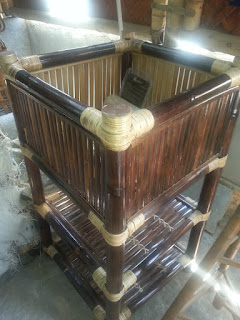
As a part of their unit on Energy and Sustainability, the grade five students were taken for a field trip to "Bamboo House India", Hyderabad. This is social and environmental enterprise owned by Prasanth and Aruna Lingam. Their main focus is to provide a range of eco-friendly ideas(specifically through the use of bamboo) to people. They have employed artisans to do a variety of things with things with bamboo: from making handicrafts and furniture to constructing an entire house!
They began their journey in 2007 and chose to work with bamboo as it a renewable source, abundantly available in this part of the world. It does not take very long to harvest and possesses high levels of strength, post treatment and seasoning. They are in the process of increasing awareness about their products and services.
'Bamboo House' also thrives to make their practices sustainable by training villagers and tribals to construct houses with bamboo and other recyclable materials. They have tied up with many NGOs to help people earn a livelihood with the help of bamboo. They are also training them to make houses with mud and reused plastic bottles. We saw a sample of this at their workshop.
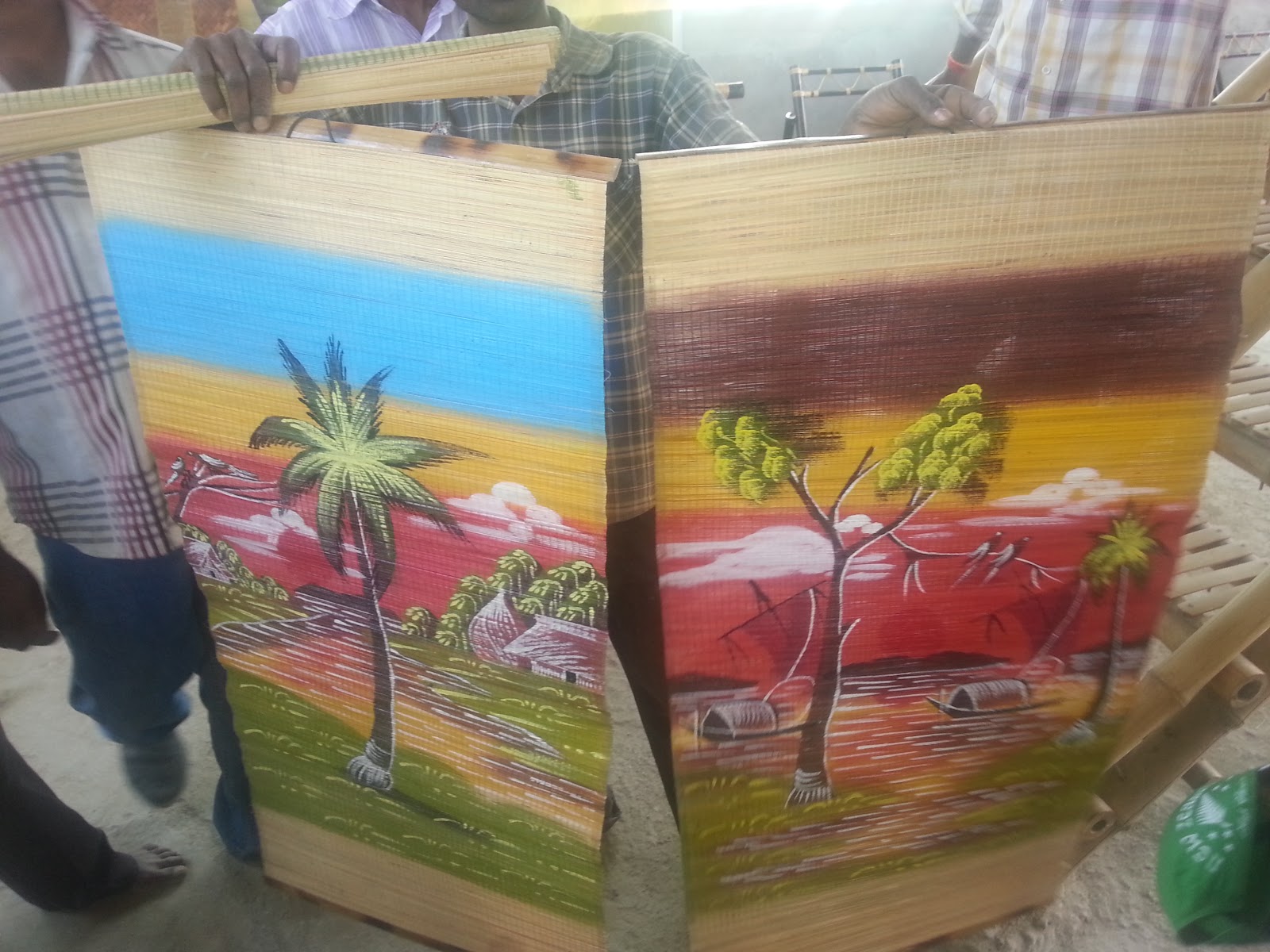
The Grade 5 students were excited to witness the versatility of bamboo during their field trip. They were also shown how bamboo is treated using malathion or boric borax. There were few models of rural and urban building designs. ALL the furniture in the owners' house was made of bamboo, including a roof-top and flooring. There was a pent house which was entirely made of bamboo. There were many smaller articles like jewellery, paintings, toothbrush holders, baskets, fruit bowls - all made of bamboo!




Reflection by Inaara Ladha:
Reflection by Amaan Rattansey:
They began their journey in 2007 and chose to work with bamboo as it a renewable source, abundantly available in this part of the world. It does not take very long to harvest and possesses high levels of strength, post treatment and seasoning. They are in the process of increasing awareness about their products and services.
'Bamboo House' also thrives to make their practices sustainable by training villagers and tribals to construct houses with bamboo and other recyclable materials. They have tied up with many NGOs to help people earn a livelihood with the help of bamboo. They are also training them to make houses with mud and reused plastic bottles. We saw a sample of this at their workshop.
The Grade 5 students were excited to witness the versatility of bamboo during their field trip. They were also shown how bamboo is treated using malathion or boric borax. There were few models of rural and urban building designs. ALL the furniture in the owners' house was made of bamboo, including a roof-top and flooring. There was a pent house which was entirely made of bamboo. There were many smaller articles like jewellery, paintings, toothbrush holders, baskets, fruit bowls - all made of bamboo!




Reflection by Inaara Ladha:
Reflection on our Journey
Today we the grade 5s went on a field trip to the bamboo house.
It was far away from school and when we got their we saw a wall. The wall was
made up of old plastic bottles with mud inside and mud on the outside. It has
mud because it makes the bottle stay on the wall. The bamboo wall is renewable
and the people’s plan is to build houses which are ecofriendly and renewable.
Those houses are for people who want ecofriendly houses.
The bamboo has a kind of sugar which ants like, so they used a
chemical called boric borax. The people keep the bamboo stick with the chemical for
10 days and then take it out. There are also plants near the place which are
bamboo trees, but they need to grow. We also many things made of bamboo.
After seeing the house I knew now that everything was made out
of bamboo. A t-shirt was also made out of bamboo and chair, stairs, necklace
and the full house!
It was a new thing for me; I never knew that houses can be build
from bamboo. The trip told me more and more information about bamboo. When I
was there I learned about bamboo, saw
bamboo, and enjoyed it so much. In my class I felt happy!!!!
Reflection by Amaan Rattansey:
Today
we went for a field trip to the bamboo house that is located in Uppal, India
We
saw many models of Urban and Rural houses that were made out of bamboo. We saw
many renewable and non-renewable things. We also saw how the water was purified
and treated well so that they could use it for furniture and many more useful
things. The chemical for the treatment of the bamboo is called Malathion Boric
Borax.
We
also saw chairs, tables, artefacts, paintings, carpets, jewellery, toothbrush
stands, holders, baskets, bells, T-shirts, fruit baskets, windows, blinds,
roofs, stools, coffee tables, etc. Everything in the bamboo house and in their
own house was made of bamboo.
We
saw many bamboo bundles and many sticks bottles and loads of mud. We also
learned small Facts like bamboo is renewable, looks good, comfortable,
eco-friendly, never stops growing and costs less. These are small point’s
research and find more.
Reflection by Sanil Bhimani:
On the 26-2-13 we went to a field trip.We went to bamboo house Uppal,India. First we went to a rural bamboo house.Over there we all saw a mam she saw us a wall which was made up of plastic bottles and mud.I was also cheap to buy in a village.It was also very helpful to our environment.In that house everything was made up of bamboo,plastic bottles and mud.It was a very ecofriendly to our environment.
After that,we saw a model of a bamboo house.The model was a bamboo house in urban places.We saw a duplex bamboo house and it was load Bering house.It could lift all the weight of the people.It was a renewable house.But today no one use bamboo house.Renewable means which can stay for a long time.
Next,we went to a tank where the bamboos were treated.First they took a bamboo,then they drilled the bamboos on the top and from the bottom and then they poured water in the tank with a chemical called malathion boric borax.They did this because the sap in the bamboo can be attracted from small insects.If the insects attracts then we need to change the bamboo after 2 or 4 years.If we mix it in the chemical so the chemical would take out all the sap and it would be used for 60 years.
After a minute we all saw a bamboo grass.Over there we saw lots and lots of bamboo.Some of them were young and some were normal.Next,we went back to school and the trip was really enjoyable and interesting.Even you would to the bamboo house and enjoy.
Monday, February 25, 2013
Inquire into Energy
http://www.energyquest.ca.gov/
http://www.energystar.gov/index.cfm?c=kids.kids_index
http://www1.eere.energy.gov/kids/
http://tiki.oneworld.net/energy/energy.html
http://www.kidsenergyzone.com/
http://www.eia.gov/kids/
http://www.energystar.gov/index.cfm?c=kids.kids_index
http://www1.eere.energy.gov/kids/
http://tiki.oneworld.net/energy/energy.html
http://www.kidsenergyzone.com/
http://www.eia.gov/kids/
Thursday, December 13, 2012
Formative assessment - How different governement systems function
Criteria:
* Knowledge about the different forms of goverments
* AK strand: Governance and civil society
* Related concepts: Governance and civil society
* Self-management skills: Making informed choices
TASK: Analyse the problem given and think how this could be solved by at least three forms of governments (Anarchy, Monarchy, Oligarchy, Democracy, Parliamentary, Communist, Federal, Dictatarian or Autocratic). You need not come up with the exact solution - just the possible procedure would be enough.
Problem: The citizens are complaining about paying too much taxes to the government. They want the taxes to be reduced.
Your response should be in the form of a comment to this post.
Friday, November 30, 2012
Weekend Homework
UOI: Home survey
Task: Talk to your parents about how your house/family is governed. Some questions you may discuss:
* What systems are in place?
* How do these systems affect your life?
* What will happen if one of the systems stops working?
* What are the responsibilities of each individual?
* What are the rights of each individual?
* How are problems solved?
* Who takes the major decisions? Why?
You can also make a pictorial representation of the same.
English: Using reading strategy: Create
Task: Make an advertisement for the book you are reading. The poster must:
* Be visually appealing with bright colours and less text
* Make the viewers want to read the book
* Have interesting captions (use simile (as __ as a ____) and alliterations (words starting from same sound) if possible)
Tuesday, October 30, 2012
Google docs project
Go to the link: https://docs.google.com/document/d/1EGxlLh-_mOOZqaXWaaog_hvBDsOJVB-nnKsBQoJU6bE/edit
Discuss the different factors that influence the design and construction of a building and write your thoughts under your group's name.
Discuss the different factors that influence the design and construction of a building and write your thoughts under your group's name.
Thursday, October 25, 2012
The power of differentiation
"Everyone is different” is a well-known
proverb. This applies to the young minds in classrooms too. Teaching and
learning in the classroom is most effective when there is differentiated
instruction. Differentiation basically means providing a learning environment
to each student that is best suitable to him/her. This sinks very well with the
student centric pedagogy of the PYP. The teacher designs the lessons in such a
way that every student's needs are met (Differentiating process). Even the level of
teaching differs based on the level of understanding and competence
(Differentiating content).
Differentiation could also means having different expectations from different
students (Differentiating product).
Here is a simple
example: A couple of days back, I asked my students to read an article based on
their unit. I gave articles to each student based on their level of
understanding of (building) concepts and reading competence. The next day, the
students who got the same article sat together and brainstormed the main ideas
- simple, yet effective.
When the students
were conferring their ideas, I went around making observations. The most
interesting part for me was the way the ESL students worked together. There are
two of them in my class - each being at a different level. In fact, one of them
can barely understand or speak any English. In the video, you can see how the
student who has better understanding of the content is trying to explain the
same to his companion. It made the partners feel very comfortable with each
other. All of a sudden, I could see a flow of confidence in them! As a result,
the one who is always too shy to work with others in the class was seen
contributing to the mind-map. It was truly a humbling experience for me as a
teacher.


'Jigsaw Gallery Walk'
'Jigsaw gallery walk' - I write this in inverted commas because I'm not sure if a strategy like this really exists. If it does, I don't know what it's
really called. Anyways, I used this strategy in the class today and felt the need to blog about it.
The students of 5K have been involved in a research project
throughout this week. They were divided into groups and each group inquired
into a different form of building/structure: Dams, Bridges, Sky scrapers,
Tunnels and Canals. They used books and internet to gather information and then
created models and posters. They also maintained a reflective journal to record
their thought process. This was their formative assessment for the first line
of inquiry.


The groups were asked to share their expertise with rest of the
class today. A clichéd way of doing this would have been to ask all the groups
to sequentially share their work with everyone. To make the process more
effective and engaging, I modified it a little bit.
Every student in each group was given a number. The groups were
regrouped in such a way that all the new groups have at least one person from
the old groups (All the 1's together, 2's together and so on). All the work done
by the students was displayed in the classroom and the groups were asked to go
around for a gallery walk. At each station, the student who was originally
involved in the project explained the facts and concepts.
This way, each student got an opportunity to communicate their
knowledge and ideas. It also made the other students comfortable about asking
questions. All the students were thoroughly engaged and excited. Saving time was another big advantage! They will now
update their journals and give them in for assessment.
A copy of the assessment sheet:
https://docs.google.com/document/d/18cJsiKLmNW-Bik2B_S3bMcGuhv3k-s_u126hfTWrvwA/edit


Subscribe to:
Posts (Atom)